
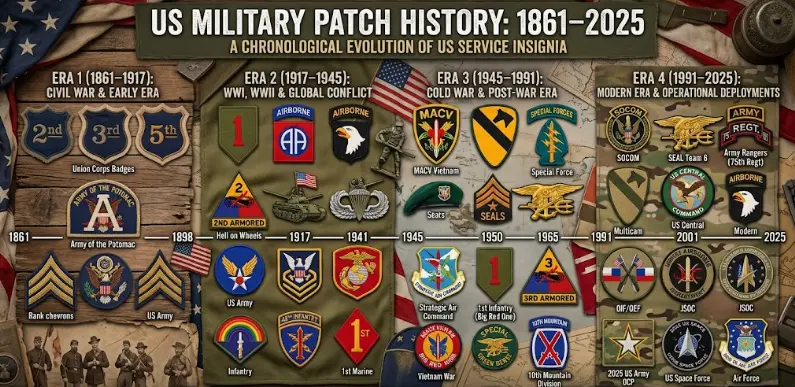
US military patches date to the Civil War, when handmade cloth insignia identified soldiers in a chaotic era before dog tags existed.
The modern system of embroidered shoulder sleeve insignia (SSI) began officially in 1918 with the 81st Infantry Division patch.
Since then, every conflict has added new chapters to the history of military patches. From WWII’s Disney-designed morale tabs to today’s Velcro-backed IR variants.
History of Military Patches: How Soldiers Were Identified in Early American Wars
When asking when did military patches start, we must look back to an era long before powered sewing machines and standardized uniforms. The overarching military patch history begins out of sheer, grim necessity on the battlefields of the American Civil War.
Civil War Makeshift Insignia (1861–1865)
During the chaotic and bloody engagements of the Civil War, identification on the battlefield was practically non-existent. Uniforms quickly became soiled, covered in mud and gunpowder, making it difficult for commanders to distinguish between different units, let alone individual soldiers.
In response to this, mothers, wives, and sweethearts began making cloth patches by hand for soldiers heading off to war. The original purpose of these early identifiers was not rooted in unit pride or heraldry; it was deeply grim. They were designed for the identification of the dead and wounded.
Dog tags did not yet exist, and a simple piece of colored fabric sewn onto a uniform could mean the difference between a soldier being identified and returned to his family or being buried as an unknown casualty. The first semi-standardized system of unit identification was introduced by Union General Phil Kearny in 1862.
Kearny implemented “corps badges” to help officers identify stragglers and quickly assess troop deployments on the field. Under this system, each army corps was assigned a specific geometric shape. For instance, the 3rd Corps utilized a diamond shape.
For even greater distinction among the ranks, the colors used for the shapes represented which division they belonged to, as the first division carried the color red, the second division carried the color white, and the third division carried the color blue.
These early unit insignia designs were usually created from felt or wool fabric and attached to the forage cap. While simple, these insignia patches designed by General Kearny became the foundation for today’s US Army military patches.
The Industrial Revolution Changes Everything
To appreciate the history of embroidered patches, one needs to take into consideration the tremendous technological changes brought upon by the second half of the 19th century.
Prior to the popular usage of the embroidery machines, which occurred between 1870 and 1890, all insignias, rank chevrons, and other ornaments featured on military uniforms had been stitched by hand. Standardization thus became a dream while widespread distribution was an extremely costly endeavor.
The creation of Isaac Singer’s sewing machine in the early 1850s paved the way for a textile revolution. Soon after, various embroidery machines, such as the Schiffli machine, began making their appearance.
By 1900, the machine embroidery technology reached a point whereby it became possible to create consistently detailed designs in huge quantities. The emergence of this capability marked a turning point in the military patch history. Standardized military insignia became a practical reality.
Millions of identical custom patches could be ordered by the military authorities for an entire division of troops. This advancement proved to be the breakthrough moment when the US armed forces could finally make the switch from cut felt shapes to elaborate embroidered patches.
World War I: The Birth of the Official Shoulder Sleeve Insignia (1917–1918)
Though the American Civil War saw the inception of this idea, the actual WWI military patches history witnessed the emergence of this system as we know it today. As the country became embroiled in the larger war, there was an immediate need for something to organize all its men.
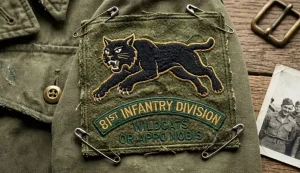
The 81st Infantry Division and the Wildcat Patch
The involvement of America in the war took place in April 1917 when the Americans rushed to mobilize troops for the war. Among the units was the 81st division, stationed at Camp Jackson, South Carolina, for training.
The unit was named after the camp where the training took place, situated in a terrain rich in fauna with a creek called Wildcat Creek. The inspiration the unit got from its environment led to the idea that would make the unit unique.
The soldiers chose a wildcat’s silhouette made of olive drab felt as the identifier for the unit. This was done by sewing the patches roughly made on the shoulders of the uniforms.
On arrival to Europe for the war, General John J. Pershing, who commanded the American Expeditionary Force in France, was initially against the unauthorized wear until he observed how cohesive the unit was due to the patches and the high morale.
It was in November 1918 that the United States Army officially approved the wearing of shoulder sleeve insignia. Due to the efforts the unit had made before, the army made an 81st Infantry Division patch as the first ever authorized insignia. This event marked the origin of the history of military patches.
The Logic Behind Early WWI Patches
One can often hear the question, “Why do soldiers wear patches during combat operations?” Back in WWI, the reason was rather tactical than anything else. Trench warfare introduced chaos to the battlegrounds like never before.
Because of the static and brutal nature of the front lines, units from various divisions, regiments, and other nations had been fighting together in the trenches and were completely mixed up after gas attacks and shelling.
Identifying units visually became vital for commanding purposes. An officer had to take a quick look at a man and know which division he was serving with, who was above him in the chain of command, and where his rally point was located.
The shoulder sleeve insignia history started with patches that served to identify a man’s unit and were placed only on the left shoulder (right shoulder patches would appear much later). Just two years after the 81st Division initiated the idea, all 18+ army divisions adopted their SSIs officially.
World War II: The Golden Age of Military Patches (1939–1945)
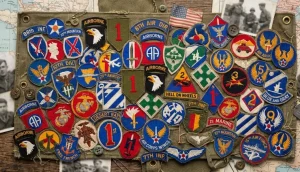
While WWI saw the emergence of SSI, WWII was the undeniable peak. Because of the colossal size of the war that encompassed the entire planet, we got an unparalleled burst of heraldic and design creativity that still distinguishes the WWII military unit patches.
Explosive Growth in Unit Insignia
World War II saw the US military increase its size like never before, from a force of about 170,000 soldiers during the peace years to a massive military with over 12 million soldiers.
Due to such immense growth, numerous divisions, task forces, geographic areas, and other specialty military units were formed, necessitating the formation of distinctive insignias for them.
To cope with the growing number of designs, the US Army established a set of rules for designing and approving patches, thus documenting a long and rich history of embroidered patches in this regard.
This was an era when some of the most recognizable US Army military patches were made. The famous patches include those of the 82nd Airborne, known as “All-American (AA),” “Screaming Eagles” of the 101st Airborne, the 1st Infantry Division’s “Big Red One,” and “Thunderbird” of the 45th Infantry.
Disney Enters the War: Morale Patches and Nose Art
Among the most interesting and distinctively American stories in military patch history are those about Hollywood. Disney played an important role during WWII in supporting the war effort. The studio assigned many of its artists to work on designing characters for a myriad of military units, and the entire process was done for free.
As a result of these activities, there emerged a whole range of Disney military patches WWII that featured well-known characters such as Donald Duck, Mickey Mouse, Pluto, and new characters invented specifically for this task.
What made Disney patches special was the fact that besides helping people identify their units, they boosted the morale of soldiers thousands of miles away from their homes.
These patches can thus be regarded as the first-ever morale patches. Due to copyright issues, however, the patches cannot be reproduced, which makes original patches created by Disney very expensive and desirable items among collectors.
The Right Sleeve Combat Patch Tradition Begins
World War II also birthed one of the most respected traditions in the US military. As the war progressed, soldiers who had served in active combat zones began informally wearing their former unit’s SSI on their right shoulder while wearing their current assignment on the left.
This practice of wearing a “combat patch” on the right shoulder was officially formalized by the Army shortly after WWII. Today, diving into combat patch history reveals that wearing a right-sleeve SSI denotes official hostile fire service.
It stands as one of the most visible, highly respected honors on a US military uniform, instantly communicating a veteran’s combat experience to anyone who understands the heraldry.
Women’s Branch Insignia and Auxiliary Patches
However, the history of military patches in WWII is not confined merely to the combatants on the field. Indeed, the period was marked by a very subtle yet tremendously important change in regard to whom patch-wearing applied to.
In particular, the Women’s Army Corps (WACs), Women Accepted for Volunteer Emergency Service in the Navy (WAVES), and even Women Airforce Service Pilots (WASPs) each created an emblem of its own. These emblems were meant to celebrate the millions of women who served in the military.
Korea and Vietnam: Subdued Patches and Special Operations (1950–1975)
With warfare evolving from the huge conventional engagements fought by Europeans to the proxy fights waged in the jungles of Asia, there came a total metamorphosis in the design, production, and use of military unit patches USA underwent a radical transformation.
The Korean War (1950–1953)
Commonly known as “The Forgotten War,” the Korean War brought about an interim period in military patch design that bridged the colorful felt designs of World War II and the present day.
Korean War patches have since become some of the most desirable patches in existence. These patches include those of famous divisions like the 7th Infantry Division, which bears the hourglass patch. The Indianhead patch of the 2nd Infantry Division and the infamous patch of the 1st Cavalry Division.
Increasing tension in the Cold War also meant the emergence of new command hierarchies throughout Europe and Asia, for example, in NATO and other commands. The establishment of each of these organizations resulted in the addition of another set of SSI to the vast catalog of the history of embroidered patches. Another addition is the 29th Infantry Division’s Ying Yang army patches.
Vietnam and the Birth of Subdued Patches
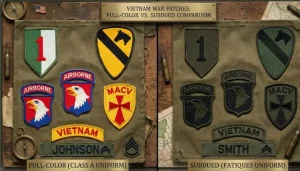
The thick and dense jungle environment of South East Asia transformed everything from tactical maneuvers to uniform designs. While patches with bright colors worked effectively in parades during World War II, the colorful patches had an inherent disadvantage when used in Vietnam, as their bright colors made soldiers easy targets of enemy snipers operating from inside the dense jungle cover.
To overcome this problem, the army underwent a complete transformation of their military uniform patches by launching subdued military patches. Such patches came in dull olive-drab green and black thread colors to ensure their uniformity with jungle fatigues.
While subdued patches became the official standard for all combat operations, colored patches were reserved exclusively for ceremonial and garrison wear. To this date, Vietnam era military patches, especially those that were hand-embroidered and produced in places like Saigon and Da Nang, are considered to be valuable items from history.
Special Forces Gets Its Identity (1955)
Another development during the Cold War period is the emergence of special units that were involved in guerrilla warfare. These units demanded special heraldic devices. The Special Forces patch history is officially traced back to 1955, when the United States Army approved the now-famous arrowhead-and-dagger patch.
Worn by the “Green Berets,” this distinctive SSI played a major role in many classified missions in Southeast Asia and soon gained popularity among the military insignias known throughout the world.
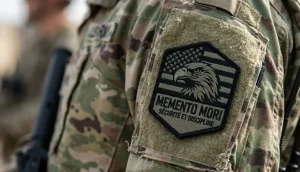
Another distinctive feature of the time was the appearance of specialized tabs above the standard SSI. Examples include such distinctive insignia as the Ranger tab, Airborne tab, and Special Forces tab, which created an instantly recognizable stacked vertical design. They were either ironed-on or sewn to the fabric.
The Cold War and Modern Era: Velcro, IR, and the Digital Battlefield (1975–Present)
Warfare entered the digital age as well as being mobile and sophisticated at the end of the 20th century and the beginning of the 21st century. The military patch history in this period is marked by a complete deviation from the traditional sewing of cloth into the latest technologies.
Operations Desert Shield/Desert Storm (1990–1991)
The Gulf War came to be the first major American military operation since Vietnam, resulting in the emergence of a totally new group of patches for the US Central Command (Centcom) theater. For most soldiers who served during the Gulf War, it became their first chance in a lifetime to earn their right-sleeve combat patch.
The sandy and arid terrain in the Middle Eastern theater led to an enormous color change in military thread, with traditional olive drab being replaced by khaki, tan, and spice brown colors used on new Desert Camouflage Uniforms (DCUs).
Post-9/11: OIF, OEF, and a Generation of Combat Patches
The tragic attacks of 9/11 led to the Global War on Terror, which gave rise to two major operations, namely Operation Enduring Freedom (OEF) in Afghanistan and Operation Iraqi Freedom (OIF) in Iraq. The duration of these wars created an unprecedented number of patch wearers in the U.S. Armed Forces since WWII.
As a result, there was a large-scale development of unit patches, various command patches specific to particular theaters, and patches for coalition forces. With the appearance of the Army Combat Uniform (ACU) in 2005, there were significant changes in military heraldry.
Namely, the new standard of digitized and subdued OCP ACU uniform patches corresponding to the universal camouflage pattern was introduced. Finally, 2005 is a landmark year in the military flag patch history because the U.S. Army made it mandatory to wear the patch on all ACU uniforms.
The Reversed American Flag: Why It Points Backward
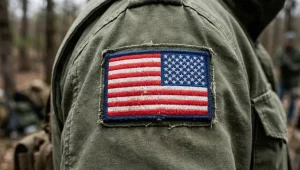
One of the most frequently asked questions by civilians observing modern troops is regarding the reversed American flag patch meaning. Army regulation strictly specifies that the flag must always fly with the union (the field of stars) facing forward.
When placed on a soldier’s right shoulder, the flag must appear horizontally reversed. This is designed to simulate the flag flying freely in the wind as the soldier “charges” ahead into battle. It is not a manufacturing mistake, a political statement, or a protest.
It reflects a century-old, deeply respected flag code standard for cavalrymen and flag-bearers in forward motion. Understanding this detail is vital for anyone researching the history of military patches.
Velcro Changes Everything (1990s–2000s)
Perhaps the most significant functional change in modern military unit patches USA is the backing material. Hook-and-loop (Velcro military patches) became the absolute standard with the rollout of the ACU and the subsequent Operational Camouflage Pattern (OCP) uniforms.
The merrowed border style was missing, but because these patches could now be ripped off and swapped between different uniforms or combat shirts in a matter of seconds. It became incredibly easy for troops to adjust their gear for multi-environment deployments. They could be laser-cut to the desired shape.
This Velcro revolution birthed an entirely new commercial market: interchangeable custom tabs, unit identifiers, and morale patches. Today, a single soldier might deploy carrying half a dozen different patches to swap out for specific mission configurations, base security protocols, or varying uniform requirements.
IR-Reflective and Subdued Modern Patches
The digital battlefield requires gear that interfaces with advanced optics. IR reflective military patches are constructed using specialized infrared-reflective film or thread that appears completely subdued and normal to the naked human eye in daylight.
However, when viewed through night-vision goggles (NVGs), these patches glow brilliantly. This technology is absolutely essential for close-air-support coordination, convoy tracking, and special operations raids, as it decisively prevents friendly fire incidents in pitch-black conditions.
Along with glow-in-the-dark (GITD) variants, these high-tech tactical patches represent the bleeding edge of the industry. They are a technological marvel, sitting as far removed from the Civil War’s hand-stitched wool felt as a modern stealth bomber is from a hot air balloon.
Morale Patches: The Unofficial History Within the History
While the Army’s Institute of Heraldry strictly governs official SSI, there is a massive, wild, and incredibly creative subculture that operates parallel to official channels. The morale patch history actually predates the famous WWII Disney designs. Informal, dark unit humor and unauthorized fabric art have existed in the trenches since WWI.
During the Vietnam War, soldiers, sailors, and pilots routinely commissioned local tailors to create highly unauthorized “party suit” patches or helmet covers that expressed their intense frustration, dark combat humor, and fierce, hyper-local unit identity.
However, it was the post-9/11 era that saw morale patch culture truly explode. The widespread adoption of hook-and-loop backing meant that unauthorized patches could be slapped onto a plate carrier or helmet during a mission and instantly ripped off before walking into the sergeant major’s office.
Today, understanding the tactical patch meaning often requires understanding inside jokes from the veteran community. Morale patches have evolved into a massive, multi-million-dollar industry encompassing tactical gear stores, independent Etsy artists, and custom manufacturers.
They sit perfectly at the intersection of rugged military culture, cynical humor, and deep personal expression. Some of the most poignant, hilarious, and creative graphic design in modern American pop culture currently lives on 2×3-inch Velcro-backed morale patches.
Branch-by-Branch: How Patch Traditions Differ Across the US Military
While the Army dominates the conversation regarding shoulder sleeve insignia history, every branch of the US Armed Forces maintains its own deeply ingrained heraldic traditions.
| Branch | Patch Tradition |
| Army | Wears the SSI on the left shoulder; combat SSI on the right shoulder. Utilizes qualification tabs (Ranger, Sapper) above the patch. The most complex and heavily regulated patch system in the DoD. |
| Marine Corps | Rejects cloth SSI on combat uniforms. Relies instead on metal unit DIs (distinctive insignia) and the ubiquitous, heavily protected USMC Eagle, Globe, and Anchor (EGA) emblem. |
| Navy | Focuses heavily on rating badges on dress uniforms, command insignia patches, and highly coveted metal warfare qualification pins (like the SEAL Trident) rather than shoulder patches. |
| Air Force | Features a rich tradition of MAJCOM (Major Command) patches and squadron patches. Maintains a very strong, officially tolerated culture of morale patches, specifically on aviator flight suits. |
| Coast Guard | Utilizes sector patches and specific rate badges. Blends a unique combination of Department of Homeland Security regulations, military discipline, and ancient maritime traditions. |
| Space Force | The newest branch (established 2019). Currently actively developing its own unique patch tradition from scratch, heavily favoring futuristic, delta-shaped insignia and PVC materials. |
Military Patches as American Culture: Collecting, Fashion, and Legacy
In addition to active duty uniforms, US Army military patches and insignias from each branch of the armed forces are considered some of the most coveted textile-based memorabilia in the history of the USA.
Historians and collectors find patches to be colorful and vivid historical artifacts that speak volumes regarding the experience of the soldier wearing them. Patches from World War II in immaculate condition from rarer parachute infantry regiments or defunct armored divisions can even sell for hundreds or even thousands of dollars on the market.
However, there is no shortage of collectors who focus on locally manufactured subdued military patches from the Vietnam era. The impact of military patches has not been limited to just veteran collectors and museums.
The high-fashion world of streetwear brands worldwide has been utilizing military patch designs extensively since the 1970s. One such item is the MA-1 bomber jacket adorned with patches of fighter squadrons.
Furthermore, the military template has been adopted by civilian organizations worldwide. High schools, varsity sports teams, local police departments, fire departments, and EMS units have all built their own organizational pride and patch traditions by directly mirroring the US military’s heraldry system.
Frequently Asked Questions
What was the first military patch in the US Army?
The first officially recognized shoulder sleeve insignia (SSI) was the 81st Infantry Division’s wildcat patch, worn in 1918 during WWI. Soldiers training near Wildcat Creek in South Carolina adopted the wildcat silhouette as their unit identifier before deploying to Europe.
The US Army formally authorized SSIs later that year, making the 81st’s patch the retroactive first in a system that now includes thousands of unique insignia and defining the question: ”When did military patches start?”
Why does the American flag patch appear reversed on military uniforms?
The reversed flag follows a centuries-old standard for flag-bearers in motion. When carried into battle, the flag’s union (the stars) faces forward, with the stripes streaming behind. On a soldier’s right shoulder, the flag is oriented to simulate this motion: stars toward the front, as if the soldier were charging forward. It was mandated on all ACU uniforms in 2005 and is the most common answer regarding military flag patch history and the reversed American flag patch meaning.
What is a combat patch, and who is allowed to wear one?
A combat patch is an SSI worn on the right shoulder of a US Army uniform. It indicates that the soldier served in a designated hostile fire area with that specific unit. Only Army soldiers who have actually served in qualifying combat operations are authorized to wear the right-sleeve SSI, technically called the SSI-MOHC (Military Operations in Hostile Conditions). As detailed in combat patch history, it is considered one of the most meaningful, highly respected, visible honors a soldier can wear on their uniform.
When did the US military start using Velcro on patches?
Hook-and-loop (Velcro) backing became widespread across the forces with the official introduction of the Army Combat Uniform (ACU) in 2005, though specific military contractors and special operations units began experimenting heavily with Velcro military patches in the late 1990s. The ACU’s loop panels allowed patches to be swapped incredibly quickly between different uniform configurations. A major, game-changing practical upgrade from the old, painstakingly sewn-on insignia.
What are IR (infrared) military patches and who uses them?
IR reflective military patches are specialized insignia embroidered with or cut from infrared-reflective material that appears entirely normal to the naked eye but glows brightly when viewed under night-vision equipment. They are used primarily by special operations teams, close-air-support units, and any ground forces operating at night to allow rapid, silent identification without emitting visible light. IR flag patches, blood type identifiers, and specific unit call-sign patches all serve this critical life-saving function on the modern battlefield.
Are morale patches officially allowed in the US military?
Morale patches occupy a highly complicated, often contradictory official space. According to strict uniform regulations, they are generally not authorized for wear on regulated garrison or dress uniforms. However, they appear widely and are heavily tolerated on range gear, tactical plate carriers, training equipment, and personal rucksacks. Deployed units often have command-approved, theater-specific morale patches for specific combat operations. The entire subculture of morale patch history is deeply embedded in US military tradition, thriving even where it is not officially sanctioned by the Pentagon.
What makes a military patch valuable to collectors?
When diving into military patch history, age, condition, rarity, and provenance are the primary value drivers for collectors. WWII-era patches in their original, unissued condition, particularly those from disbanded units, Disney military patches WWII, or early war years featuring handmade bullion characteristics, are among the most valuable. Vietnam era military patches (specifically the theater-made subdued variants) and Cold War-era covert specialty unit patches are also highly collectible. Theater-specific patches from Operations Desert Storm, OIF, and OEF are rapidly gaining value on the market as the veterans of those conflicts age and comprehensive collections mature.
Can civilians order custom patches that look like military insignia?
Civilians can certainly order custom patches that are heavily inspired by or pay respectful tribute to historical military designs. However, creating exact, 1:1 reproductions of official US government insignia for the specific purpose of impersonating active military personnel (Stolen Valor) is strictly illegal under federal law (18 U.S. Code § 702). Trusted, veteran-aware patch makers like Patch Makers USA routinely produce custom military patches USA that honor and celebrate military tradition while remaining legally and clearly distinguishable from official, active-issue government insignia.
Custom Military Patches Today (What Has Changed and What Has Not)
When you are researching “Why do soldiers wear patches today?” The reason behind this has not been altered at all from the time the 81st Division sewed wildcats onto their sleeves in 1918. It is still all about identifying the individual soldier, representing the team, and honoring those brave men and women who bore the symbol before them.
But there has been a radical shift in how these patches are made. In modern times, they are created through advanced industrial stitching techniques, PVC forming processes, sublimation printing, and laser cutting.
They are now designed using high-quality materials and produced by specialized factories that recognize the weight of military heraldry. The companies that know the history of military patches and are trusted by veterans, such as Patch Makers USA, manufacture these custom military patches USA with full knowledge of what these insignias mean to the soldiers who bear them.
Today’s technology allows for an easy-to-use ordering process that includes free color proofs and Pantone color matching and no minimum order quantity. Something a Civil War mother could never dream of as she worked by candlelight. Contact us to get a quote for free.
