

Your customers want the rugged, heritage vibe of leather patches but they’re also asking how it’s made, what it’s made from, and whether your “eco claims” are real or just green pixie dust.
If your merch team is juggling brand standards, sustainability goals, and retail compliance, this guide breaks down the actual choices: LWG-rated tanneries, credible vegan alternatives, and labeling that won’t trip you up later. You’ll walk away with a plan that looks premium, reads honest, and ships on time.
And if you’re new to leather in general, grab the fundamentals here: Everything You Need to Know About Custom Leather Patches, great primer for product, ops, and brand teams alike.
What “Ethical Leather” Actually Means
Let’s skip the fuzzy buzzwords. For Custom Patches that use real leather, “ethical” usually points at three buckets:
- Responsible tanning and water management
Leather Working Group (LWG) audits tanneries for environmental performance, chemicals, water treatment, energy, and traceability. Ratings (Bronze/Silver/Gold) signal how dialed-in a facility is. If you’re ordering custom logo patches for hats or jackets at any scale, an LWG-rated source sets your baseline. - Traceability & restricted substances
You want clear paperwork on where the hide was processed and proof your patch meets limits for chromium VI and other nasties. This isn’t just feel-good, it’s buyer-approved. If you sell nationwide, different retailers will ask for it. - Longevity & repair
An honest sustainability claim includes durability. A leather patch that outlives the hoodie is actually better for the planet than a flimsy alternative that heads to landfill in six months.
How LWG Ratings Show Up in Your Purchase Order (and on the swing tag)
- Sourcing note: “Leather sourced from LWG-rated tannery” is a clean, truthful statement. No halo effects, no overpromising.
- Audit level: If your marketing team wants to brag, say “LWG Gold-rated tannery” only when the docs match your exact batch and tannery.
- Color/finish constraints: Higher-performing tanneries have tighter, more consistent finishing lines, great for brand consistency (your “espresso brown” should look the same across hats, bags, and aprons).
Pro move: back-stamp or include a tiny care card with the LWG note and a short care tip. That single line can lift perceived value and retention.
Vegan Alternatives that aren’t Greenwashing
“Vegan leather” is a big umbrella. Some materials are plant-based; some are polyurethane (PU) on a fabric backer. Both can be valid, just label correctly and avoid pretending PU is a forest.
What’s on the menu for custom clothing patches:
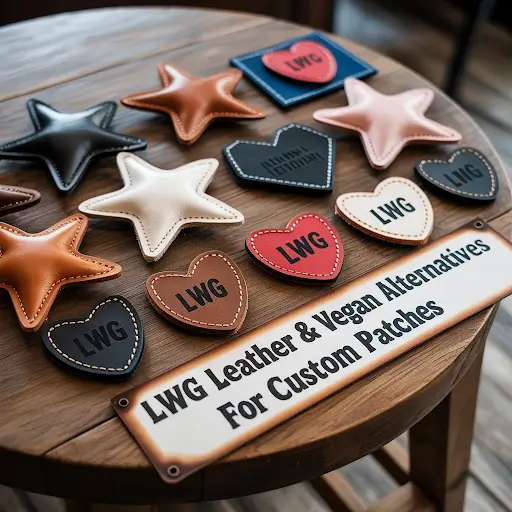
- PU (polyurethane) “leather”: The workhorse. Good for crisp debossing, color control, and fast turnaround. Pick a high-grade PU with recycled content where possible and specify a quality topcoat for scuff resistance on custom name patches for bags and backpacks.
- Cork: Lightweight, tactile, very “natural” look. Great on hats and journals. Takes laser-etch art beautifully.
- Apple/cactus/pineapple blends: Fun story, niche availability. Good for limited drops; make sure you get performance data and honest composition sheets (plant % versus polymer %).
- Recycled leather fiber (bonded): Uses leather offcuts with a binder. It reads “real” in hand while reclaiming waste. Label it as recycled leather fiber, not “full-grain.”
Labeling that won’t bite you later:
- “Vegan leather (PU)” or “PU leather”, accurate and clear.
- “Plant-based composite with PU binder” if you’re in the alt-leather zone.
- Avoid “eco-leather”, it’s not a recognized standard and screams greenwash to savvy buyers.
Design Choices that Make Ethical Patches Look Expensive (and last longer)
- Laser > over-inking: Laser etch or clean deboss reduces chemical load and feels premium on both leather and PU.
- Contrast stitching: Organic cotton or recycled poly thread in a contrast color shouts “intentional” design.
- Edge finishing: Burnished or folded edges wear better on denim and canvas.
- Backings that fit the garment: Heat-seal for cotton blends, sew-on for heavy canvas and outerwear, Velcro for workwear that needs quick swaps. (Yes, Custom patches Velcro has a time and place.)
If you’re building a full line, custom patches for hoodies, custom biker patches for jackets, custom hat patches, consistent edge treatment and stitch thread unite the collection (and save you from re-shooting product photography).
Truthful Labeling Beats Clever Copy Every Single Time
Here’s the “keep us out of trouble” checklist your copywriter will actually use:
- Say exactly what it is: “Genuine leather,” “PU leather,” “recycled leather fiber,” “cork,” etc.
- State the source standard only when verified: “Made from hides processed at an LWG-rated tannery.”
- Avoid absolute eco claims: “Planet-friendly,” “eco-leather,” “sustainable leather” without proof = red flags.
- Add care instructions: Longer life = lower footprint.
- Country of origin + tracking code: Retailers will love you; ops will too.
Cost, Lead Times & “Do We Need to Retest Every Color?”
Short answer: not always, but don’t guess. Real leather varies by dye and finish; PU varies by coating. If you’re selling wholesale, set one validated master spec (substrate + finish + adhesive/backing) and stick to that “chemistry family” to limit re-testing.
For speed, run pilots stateside with a custom patch maker near me (translation: a reliable USA shop), then scale volume once the look is locked.
If you’re weighing embroidery for other SKUs, cross-price against Custom Embroidered Patches to see where stitch count vs. leather/PU balances out for Custom Patches at Low Prices targets.
Building a Clean Audit Trail (buyers will ask)
- Spec sheet: substrate (leather/PU/etc.), finish, color, thickness, backing.
- Compliance folder: LWG certificate (if leather), restricted-substance declarations, and any Prop 65 stance if you sell in CA.
- Labeling mockups: exact wording for fiber/content, country of origin, and care.
- Photos of stamps/tags: proof that what’s in the doc is what hits the shelf.
If your retailer wants five colors and three sizes, use that master spec strategy: validate once, extend many. That’s how you keep fast turnaround custom patches USA tight while expanding assortments.
Ordering Flow (no drama, just clean steps)
- Design your custom patch and order: send vector art, pick leather vs. PU/cork, choose deboss or laser.
- Lock specs: choose backing (sew-on, heat-seal, Velcro), edge finish, and thread color.
- Proof & (if needed) test: confirm finish match and labeling.
- Produce: USA or nearshore for speed; offshore for volume once the spec is proven.
- Reorder math: set a reorder point based on your sales velocity and lead time, then let us automate reminders so you don’t stock out before the next drop.
FAQs
1) What does an LWG rating actually mean for my custom patches?
LWG (Leather Working Group) audits tanneries on chemicals, water treatment, energy use, and traceability. An LWG Bronze/Silver/Gold rating tells buyers your leather came from an audited facility, not mystery-tan land. If you’re selling custom logo patches for hats, jackets, or bags, listing “Leather sourced from an LWG-rated tannery” is a clean, truthful claim.
2) Will vegan or LWG-sourced options blow up my lead times and costs?
Not if you spec smart. LWG leather from common colors/weights is usually fast turnaround friendly. PU often moves even quicker. Pricing depends on finish, thickness, and backing, similar to other Custom Patches choices. Lock a master spec, then scale SKUs to keep testing and reproofs light.
3) Are vegan “leather” patches legit or just plastic with PR?
Both exist. High-grade PU (polyurethane) can be durable and crisp for deboss/laser; cork and recycled leather fiber are strong alternatives; plant-blend materials (apple/cactus/pineapple + PU binder) work for limited drops. Just label accurately: “PU leather,” “cork,” or “recycled leather fiber.” Avoid fuzzy terms like “eco-leather.”
4) What’s the right way to label leather vs. vegan patches so I don’t get flagged?
Say exactly what it is (e.g., “Genuine leather,” “PU leather,” “recycled leather fiber”), add country of origin, care tips, and, if applicable, “Leather sourced from an LWG-rated tannery.” Avoid absolute claims (“sustainable,” “planet-friendly”) unless you can substantiate them. Truth beats clever copy.
5) Which backing should I choose for ethical patches on real garments?
Match the use case: heat-seal for cotton blends (hoodies/tees), sew-on for denim/canvas and high-abrasion zones, Velcro for workwear and quick swaps. For custom patches for small businesses or retail sets, keep one validated backing across SKUs to simplify reorders.
Ethical can be Beautiful, Durable, and Profitable
You don’t have to choose between “looks premium” and “reads responsible.” With LWG-rated leather (or a clearly labeled, high-performing vegan alternative), honest storytelling, and smart packaging, your patches will pass the sniff test, from merch managers to eco-minded customers.
Ready to spec Custom Leather Patches (or a vegan stand-in) that actually back up your brand values? We’ll map materials to your garments, dial the finish, and set labeling that buyers approve the first time. Questions on timelines, testing, or pricing? Contact Patch Makers USA team and we’ll get you a fast, clear quote, no greenwash, no guesswork.
