
Kids will trade anything, stickers, snacks, sibling secrets. Pins are catnip. Which is exactly why brands can’t treat youth merch like “just another cute SKU.” If your custom pins touch the youth aisle, you’re in compliance country: CPSIA at the federal level and California Prop 65 on the West Coast.
Good news: with the right specs, testing, and labeling, you can protect your audience and your margins, without slowing launches to a crawl.
If you’re still scoping formats and price tiers, start with the basics on our Custom Pins page, styles, backings, and MOQs for schools, camps, and youth programs.
What Counts as a “Children’s Product” (And Why You Should Care)
CPSIA’s definition is basically: made for or primarily marketed to kids 12 and under. So if your custom lapel pins appear in kids’ apparel, school store fixtures, STEM/camp kits, youth club swag, or toy-adjacent packaging, assume children’s product rules. That means:
- Third-party testing at a CPSC-accepted lab
- A Children’s Product Certificate (CPC) you supply to retailers/marketplaces
- Tracking labels (who/when/where you made it) on product/card
- Checks for sharp points/small parts risks for the intended age group
- Heavy-metal limits in metal and coatings
None of that is scary with a decent plan. It’s a process, not a pop quiz.
And while we’re talking wear: if you’re putting lapel pins on blazers for ceremonies, brush up on good form with What are the Rules and Etiquettes to Wear Custom Lapel Pins?, useful for school boards, scouts, and honor programs.
CPSIA in Plain English: Your Checklist
Here’s the sanity-saving flow most brands use for youth-safe custom enamel pins and custom lapel pins:
- Age grade the product.
Is it for 6+, 8+, or 12+? Pins aren’t toys, but age grading influences warnings, packaging, and small-parts considerations. - Pick child-friendly materials.
- Recycled or virgin brass/stainless for the base (solid, low risk).
- Nickel-free or sealed finishes where feasible, especially for sensitive skin.
- Rubber or locking clutches to reduce poke/lose hazards on custom hat pins and backpacks.
- Avoid loose embellishments that could detach on under-8s.
- Define the finish & color system.
You can still go hard enamel or soft enamel, just commit to compliant paints/inks and protective topcoats. Minimalist die-struck looks (no color) also reduce chemical exposure and look premium. - Testing & documentation.
- Send your final spec to a CPSC-accepted lab.
- Get results, keep them on file, and issue your CPC with each batch.
- Make sure packaging carries a tracking label (batch/date/origin).
- Packaging & warnings.
Use sturdy card backing that won’t release the pin in transit. Clear “Not for children under [age]” where relevant. Retailers love clean, transparent packaging, so do parents. - Production partners.
Work with pin makers who already know the drill. If your vendor blinks at “CPC,” keep walking.
Prop 65 Without the Headache
California’s Prop 65 requires a warning if exposure to certain listed chemicals is above “safe harbor” levels. In the pin world, that usually means minding heavy metals in metal/coatings and certain chemicals in adhesives/inks. Your game plan:
- Design to avoid the warning where possible (nickel-free options, sealed finishes, compliant inks).
- If your retailer requests a warning anyway (conservative approach), use the correct, current language and place it on product or packaging.
- Keep lab reports handy. Buyers will ask.
Design Choices That Make Compliance Easier (and Better Looking)
- Die-struck + antique finish: No color baths, museum-grade vibe, easy path through testing.
- Shorter color stack: Fewer pigments = fewer variables. Your brand spot color + metal is often all you need.
- Nickel-free or PVD finishes: Durable, skin-friendlier, and retail-ready for youth.
- Hardware matters: For school uniforms and lanyards, use locking clasps; for younger age groups, consider rubber backs on lanyard pins and backpacks.
- Back stamp the proof: Batch code + country of origin = tracking label done.
“But We’re a Small Team, Can We Still Do This?”
Absolutely. Whether you’re a PTA fundraiser, a kids’ brand doing promotional pin giveaways, or a national retailer planning bulk custom pins, you can go from art file to compliant shelf stock without spinning up a legal department.
Here’s a nimble path many first-timers use:
- Phase 1: Pilot (no-drama)
- Start with one size (1.0–1.25″).
- Choose a safe metal (brass or stainless) and a nickel-free finish.
- Keep colors to one or two.
- Do lab testing once, validate the formula, keep your CPC on file.
- This is great for custom lapel pins no minimum style pilots or regional store tests.
- Phase 2: Scale (retail-ready)
- Lock packaging (sturdy cards, clear age grade, tracking label).
- Order custom pins bulk using the validated spec.
- Expand to lapel pins with logo, custom pin badges, and custom pin flags variants using the same “chemistry family” so retesting is lighter.
- Phase 3: Specialty (seasonal/collab)
- Add a glitter, glow, or printed element but confirm compliance first.
- Kids love novelty; compliance says, “test it, then party.
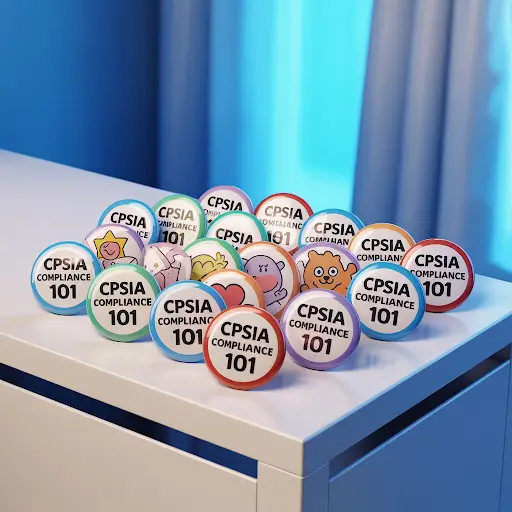
Marketplace & Retail Reality: What They’ll Ask For
If you sell via national chains or platforms:
- CPC + lab report PDFs ready to share
- Tracking label example photo
- Prop 65 stance (warning language or exemption basis)
- Artwork & spec sheet (metal, finish, fill, hardware)
- Country of origin and batch coding approach
If any of that makes your eyes glaze over, hand us the to-do list. We function as your custom pin maker and compliance assistant so you can… you know… market the thing.
Ops Tips for Schools, Camps, and Youth Brands
- Lock the clasp. Rubber backs are comfy; locking clutches prevent lost pins (and nurse’s-office visits).
- Card smart. Rounded corners, no easy-tear zones where the pin can slip out.
- Avoid tiny parts for under-8s. If it can detach and fit in a tester tube, rethink it.
- Clear adult install note for younger kids, parents and teachers appreciate the heads-up.
- Reorder ready. Use one validated spec across multiple designs to cut testing cycles and keep your order custom pins timeline short.
If your product line includes hats, align your posts/clutches to the fabric thickness and sweat factor. We dial this on Custom Hat Pins so you don’t get returns from bent posts or lost pins.
Plating, But Make It Kid-Safe (and Pretty)
You can still go gold, black, or rainbow and keep compliance tight. Many teams pick:
- Nickel-free gold tone for ceremonies and awards
- PVD black for sports clubs and esports vibes
- Antique brass for school crests and scouting
For side-by-side visuals and pros/cons, that plating article again: Best Plating Options for Custom Designed Pins in the USA. Share it with design and sourcing so everyone lands on the same finish.
Common Myths, Busted!
- “Compliance means ugly.” Nope. Minimalist die-struck looks and nickel-free gold are chef’s kiss.
- “Testing will blow our budget.” It’s cheaper than a recall. Validate one master spec, then reuse.
- “Prop 65 means we can’t sell in CA.” It means be smart: design to avoid warnings, or use the correct one if needed.
- “We can copy last year’s vendor spec.” Materials change. Re-validate anything you didn’t produce.
Ordering Flow (Kid-Safe, Retail-Ready)
- Create custom pins: send vector art + age target + where they’ll be worn (hats, backpacks, jackets).
- Pick materials/finish: brass/stainless, nickel-free or sealed plating, locking clasps.
- Proof + test: we finalize art, then route a compliance lab test and generate your CPC.
- Produce + pack: sturdy cards, tracking label, optional Prop 65 language.
- Ship: you list, launch, and restock without compliance drama.
FAQs:
1) Do custom pins for kids always count as “children’s products” under CPSIA?
If the item is primarily for kids 12 and under (school stores, youth clubs, camp merch), assume yes. That means third-party lab testing, a Children’s Product Certificate (CPC), and tracking labels. If you’re unsure, age-grade your design and packaging and we’ll advise before you order custom pins.
2) Can I still use hard/soft enamel and gold/black finishes?
Totally. You can spec custom enamel pins with compliant paints/inks and nickel-free or sealed plating. We often recommend PVD or nickel-free gold/black for kid-safe custom lapel pins, great look, easier compliance, fewer skin-sensitivity issues.
3) What documents do retailers or marketplaces usually ask for?
Expect: (a) lab test reports from a CPSC-accepted lab, (b) a CPC that matches your batch, (c) a tracking label (on card and/or back stamp), and (d) your Prop 65 stance (warning or basis for no warning). We prep the paperwork so your custom pins with logo are buyer-ready.
4) How do I package pins to pass small-parts and safety checks?
Use sturdy carding that secures the post, rounded corners, and age grading. For school/lanyard use, add rubber or locking clasps. Clear adult-install notes help for younger age groups. Good packaging = fewer headaches and happier buyers.
5) Will compliance slow me down or kill my budget?
Not when you plan it up front. Validate one “master spec” (metal, plating, color system, hardware), test it once, then roll out variants as bulk custom pins with the same chemistry. That keeps timelines tight and costs sane, especially for seasonal or school programs.
We Make Kid-Approved, Parent-Proof Pins!
We build custom pins with logos for schools, youth brands, clubs, and national retailers, fast proofs, clear guidance, and paperwork that passes the buyer sniff test. Whether you’re testing a tiny run (custom pins no minimum scenarios) or scaling bulk custom pins, we’ll spec the right metal, finish, and packaging to keep both compliance and conversions happy.
Contact Patch Makers USA team for a fast, clear plan, and get your next youth drop retail-ready without the red tape vibes.
