
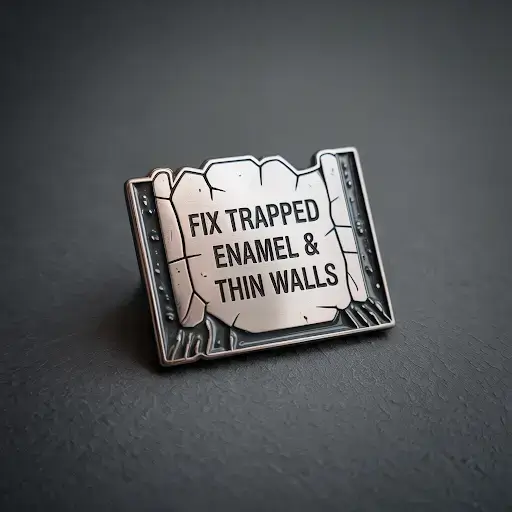
Designing enamel pins looks deceptively simple, a few bold lines, some color fills, and boom, you’ve got a collectible. But any brand or designer who’s been through a rejected die, a chipped enamel, or a weirdly warped corner knows it’s not that easy. There’s a fine art to the die-line, that thin, crucial outline defining your metal borders and the entire pin structure.
If you’re a business or brand using enamel pins for marketing, merch, or resale, understanding die-line discipline isn’t optional. It’s what separates a sleek, premium pin from one that feels off, breaks easily, or just doesn’t meet your quality expectations.
Let’s unpack what goes wrong (and how to fix it), especially when it comes to trapped enamel, thin walls, and those sneaky dead corners that can ruin your batch before it even hits production.
The Die-Line Dictates Everything
Your die-line is the blueprint your manufacturer uses to cut metal molds. Every shape, border, and partition depends on how accurately your die-line is built. When it’s sloppy or inconsistent, problems ripple through every stage, from metal fill to polishing.
For instance, when your die-line gaps are too narrow, the enamel can’t flow correctly into the recessed areas. Too wide, and your pin starts losing its structural integrity. That’s why professional pin makers (like us at Patch Makers USA) obsess over die-line precision before anything else because fixing it after casting is impossible.
Trapped Enamel: The Silent Saboteur
Trapped enamel happens when your colour areas are enclosed without an outlet during the filling or firing process. Think of it like a tiny pool of colour with no way to “breathe” or settle properly, it ends up either bubbling, cracking, or not filling evenly.
It’s a nightmare for both soft and hard enamel pins, especially in complex designs with multiple enclosed zones.
How to avoid it:
- Keep pathways open: Make sure your design allows every enamel area to connect or vent through another opening.
- Plan your colours with logic: Each colour should have enough metal boundary to hold it, but not so isolated that it traps liquid enamel.
- Collaborate with your manufacturer: Send editable vector files,not just PNGs, so they can tweak or flag potential traps before production.
This single issue can turn an otherwise brilliant design into a reject pile. That’s why our design review process always checks enamel flow feasibility before die creation.
If you want a broad lay of the land first, formats, use cases, promo math, skim All Types of Enamel Pins & Why They Work as Promo Tools for context before you finalize the die strategy.
Thin Metal Walls: The Break Point You Don’t See Coming
Brands love intricate detail, thin lines, micro text, delicate shapes. But here’s the kicker: those aesthetic details are often the first to fail in production.
When your metal walls (the raised borders in the pin) are too thin, they don’t hold enamel well and tend to bend or break during polishing or plating. Anything below 0.2 mm in the die-line is usually a red flag.
The fix:
- Keep walls between 0.3–0.4 mm minimum. This range balances precision with durability.
- Avoid super-tight spaces. The smaller your enamel cells, the harder they are to fill cleanly.
- Consider metal finish and polishing pressure. Some finishes (like black nickel) accentuate flaws from thin borders more than others.
At Patch Makers USA, we often re-engineer artwork for brands who come with detailed vector designs that just won’t survive the moulding process. Our goal is to keep your visual intent intact, without risking a fragile batch.
Dead Corners: Small Angles, Big Problems
Ever noticed a pin with a weird dent in a corner or a shape that didn’t quite cast right? That’s often because of “dead corners”, sharp internal angles where metal flow during moulding or plating gets trapped or uneven.
When molten metal or enamel tries to reach those tight corners, it cools unevenly, causing air pockets or incomplete fill. The result: dull edges, inconsistent plating, or chipped corners.
Best practices:
- Round off internal corners. Even a subtle 0.1 mm curve can save your mold.
- Avoid acute intersections. Anything below 45° invites casting inconsistencies.
- Test-render before committing. A simple 3D preview can expose dead zones long before production.
These tiny tweaks make a massive difference in final quality, especially for mass-produced pins where one flaw can repeat across hundreds of units.
The Business Impact: Why This Matters Beyond Design
For brands, every rejected batch means cost, not just in money, but in reputation. When your enamel pins arrive chipped, inconsistent, or off-spec, you don’t just lose product; you lose customer confidence.
Let’s say you’re a brewery, gaming label, or fashion brand using enamel pins as part of your merch or promo packs. A bad batch delays launches, eats up budget, and dents your image of quality craftsmanship.
But when your designs respect die-line discipline, production becomes predictable, repeat orders become seamless, and your pins feel premium, every single time.
Pre-Production Checks: The Smart Brand’s Safety Net
Before sending your final artwork to manufacturing, make sure you (or your production partner) tick off these essentials:
– Vector artwork only: Adobe Illustrator files with clean, closed paths.
– Uniform line weights: No mix of ultra-thin and thick lines within the same element.
– Spacing check: Minimum 0.3 mm gap between any two metal edges.
– Color layers properly labelled. It helps manufacturers prep enamel batches faster and more accurately.
– Preview mockups in both metal and enamel view. This is key to spotting potential traps early.
Metal Matters: The Backbone of the Die-Line
The metal type you choose plays a big role in how forgiving (or not) your design will be. Harder metals like iron or brass can handle thinner lines, while softer alloys might distort if pushed too fine.
Here’s how the choice impacts die-line behaviour:
- Brass: Perfect for soft enamel pins with medium-thick walls. Excellent for maintaining clean lines.
- Iron: Affordable, strong, but not ideal for hyper-detailed art because of harder mould creation.
- Zinc Alloy: Great for 3D pins, but avoid razor-thin die-lines, they won’t hold.
- Copper: Beautiful finish but can warp easily if walls are too thin.
Pro tip: Always tell your pin maker what finish and plating you’re after (black nickel, gold, antique silver, etc.) before finalising the die-line. Each reacts differently to pressure and heat during plating.
At Patch Makers USA, we walk you through all of this before your order ever hits the machine. Whether you’re doing custom logo pins for brand merch or limited-edition collector drops, we make sure the die-line and metal combo actually make sense for production, not just for the design board.
Enamel Behaviour: Liquid Logic You Can’t Ignore
Enamel is not paint, it behaves like a liquid that has to settle, level, and then cure under heat. So when your die-line geometry ignores how enamel moves, you end up with underfills, uneven colour, or chipped cells after plating.
Different enamel types have different personalities:
- Soft enamel: Flows easily but tends to overfill if your walls aren’t consistent.
- Hard enamel: Needs perfect metal boundaries; it’s ground flat after firing, so any unevenness in die-line = ugly metal scratches.
- Transparent enamel: Demands clean recess depths, otherwise it reveals every imperfection.
When you design with enamel behaviour in mind, not against it, your pins will age better, polish cleaner, and sell faster.
If you need help steering choice of finish for audience and use case, revisit the deep dive: Hard vs. Soft Enamel Enamel Pin: Which One is Right for You? and align your team in five minutes.
Quality Testing: Pull, Press, and Polish
You wouldn’t launch a car without a test drive, so why skip testing your pins before mass production? Brands that do small pre-runs catch 90% of potential issues before they scale.
Here’s how we test at Patch Makers USA:
- Pull & bend check: We test die strength under minor flex pressure.
- Plating consistency: Ensures every pin shines the same under light.
- Colour adhesion test: Each enamel area is examined post-polish for lift or crack potential.
- Edge feel: Because if a customer runs their thumb over a rough edge, you’ve already lost them.
When you’re testing, also review your die-line adjustments post-sample. A single tweak (like widening one wall or rounding one sharp inner edge) can save you thousands in reprints.
Real Talk: What Happens When Brands Skip Die-Line Discipline
Here’s what skipping die-line discipline actually looks like in the wild:
- Your enamel fills start lifting after a few wears.
- Lines look soft or blurred, especially after polishing.
- Plating overlaps the design edges (metal “bleed”).
- Your logo text becomes unreadable once shrunk down.
- Corners chip in bulk shipments.
All these are avoidable with proper file prep, communication, and a manufacturer that doesn’t just “print what you send.”
That’s why working with a custom lapel pin manufacturer in the USA that checks your art files, reviews die-lines, and sends previews before cutting the mold can make or break your product line.
Collaboration Over Assumptions: How Pro Brands Do It Right
Some of the smartest brands we’ve worked with (from breweries to sportswear and creative agencies) don’t just “order custom pins.” They collaborate.
They send vector files, take manufacturer feedback seriously, and tweak their die-lines with production in mind.
When you order from Patch Makers USA, you’re not throwing your design into a production void. You’re getting pro feedback from pin engineers who’ve seen every mistake and know how to dodge it.
Whether you’re ordering custom logo pins for hats, branded jacket pins, or even custom team pins for sports uniforms, our in-house designers check every die-line before mould cutting. Because nothing screams “premium brand” like flawless execution in a tiny 1.25-inch piece of metal art.
FAQs
Q1: What is a die-line in enamel pin design?
A die-line is the metal outline that defines the structure of a pin. It determines where enamel fills go, how colours separate, and how the pin will physically cast in metal.
Q2: Why does trapped enamel happen in custom pins?
Trapped enamel occurs when enclosed colour areas don’t have open flow paths, causing air bubbles or uneven fills during firing. Proper die-line spacing prevents this.
Q3: How can I avoid thin metal walls in my pin design?
Keep your walls between 0.3–0.4 mm for strength and clean enamel separation. Anything thinner risks bending or breaking during polishing or plating.
Q4: What are “dead corners” in pin manufacturing?
Dead corners are overly sharp angles where metal or enamel can’t flow properly, leading to incomplete fills or weak points in your pin’s structure.
Q5: How does die-line precision affect brand quality?
Perfect die-lines mean cleaner finishes, longer-lasting pins, and fewer rejects — saving brands money while elevating perceived product quality.
Q6: Who can help me fix die-line or enamel issues?
Patch Makers USA’s design team reviews every file before production to ensure your die-lines, fills, and finishes meet pro-grade manufacturing standards.
Q7: Can die-line mistakes impact enamel colour quality?
Absolutely. Incorrect die-line spacing can cause colours to bleed or lift during curing, especially in hard enamel pins. Clean geometry ensures colour stability.
Q8: What’s the best metal for detailed die-line work?
Brass and iron are top picks. Brass balances durability and detail, while iron offers affordability for simpler designs. Your manufacturer can recommend the best fit.
The Die-Line Discipline Difference
At the end of the day, die-line discipline is the difference between just another pin and a collector-grade brand statement. Every trapped enamel bubble, thin metal wall, or dead corner is a reminder that precision matters more than flash.
So before you rush to upload your next design and hit “Order,” pause and perfect your die-line. Or better yet, let the experts at Patch Makers USA handle it for you.
Ready to create pins that nail every detail? Contact Patch Makers USA today and let’s make your next batch flawless, fast, and factory-perfect.
