
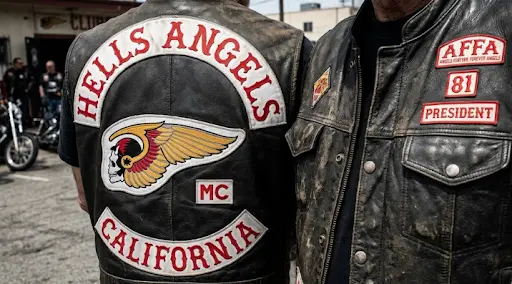
While the roar of a large V-twin engine can indicate the approach of a biker, it is the leather jacket that truly speaks of their past. The designs adorned on the backs of bikers have done just that for many years now, declaring the strength of their brotherhood and loyalty, as well as their territorial dominance.
Decoding the complex world of motorcycle club patches reveals a fascinating subculture steeped in rigid traditions, fierce independence, and uncompromising respect. Understanding these powerful visual identifiers offers a rare and captivating glimpse into the closely guarded lifestyle of legendary organizations like the Hells Angels.
History of Motorcycle Club Patches
The history of motorcycle club patches is rich and can be traced back to the post-war years that immediately followed WWII. With thousands of war veterans who sought to re-experience the adrenaline rush, camaraderie, and excitement felt in battle, many of them bought cheap, used military bikes and rode them in groups in order to have some fun after the war.
At first, members simply wore unified clothes or customized leather jackets with designs to differentiate one group from another. Later, with further development of such groups into organized clubs, the need for unique visual identifiers emerged; thus, the first emblems were created.
One of the turning points in biker culture happened in 1947 during the notorious riot in Hollister, California. After this event was extensively covered by the press, the division between regular bike fans and hardcore bikers became clear. Those groups that adopted a tougher stance started using increasingly elaborate biker patches to mark their difference from the rest of society.
In addition to being decorative elements, these biker vest patches gained much symbolic meaning and came to represent everything about a biker, including his identity, the place in which he lives, and, most importantly, his loyalty to his brothers.
Hells Angels Motorcycle Club (HAMC) is an international outlaw motorcycle club that was created in California. Members of the Hells Angels tend to ride Harley Davidson bikes.
In the USA and Canada, the Hells Angels operate under the name Hells Angels Motorcycle Corporation. The Hells Angels are known to be associated with criminal activities, including the trade of narcotics and conflicts with rival outlaw motorcycle clubs.
What Is a 3-Piece Patch?
In the highly hierarchical organization of bikers, the three-piece patch is considered to be the highest badge identifying a legitimate and traditionally organized motorcycle club.
Wearing such a set of custom embroidered patches is earned after a biker individual goes through many years of hard work, dedication, sacrifice, and full loyalty to the organization.
Each piece of the three-piece set is specially designed, and each bears a great significance and weight within the organization. The top piece of the set is called “top rocker,” and it prominently shows the name of the motor cycle club in large letters.
The second piece of the set shows the patch or the logo of the motorcycle club. For the Hells Angels, it is their Death Head with wings. The third part of the set shows the name of the particular geographical area where the club rules.
Besides the main pieces of the three-piece set, you may see a small square patch called “MC.” It signifies that the group is a traditional motorcycle club. In order to have the right to wear a full set, one should first successfully pass the trial period during which he/she is considered “a prospect.”
What Is the 1% Patch?
There is no doubt that the notorious 1% diamond patch stands out among all the other symbols associated with the biker subculture due to its extreme notoriety. The background for introducing such a distinctive emblem can be traced back to events taking place after the infamous riot in Hollister, which took place in 1947.
It was reported that in order to save the reputation of motorcyclists, the American Motorcyclist Association issued a statement claiming that 99% of the motorcycling community consists of law-abiding individuals, whereas all the problems are caused by only one percent of deviant members.
Far from being offended by such a statement, the tough anti-establishment bikers proudly embraced it. Wearing a 1% patch on their leather vests, these bikers make it absolutely clear that they are beyond all the legal requirements imposed by society as well as any regulation concerning their behavior.
In fact, this distinctive patch symbolizes membership in outlaw motorcycle gangs. It makes it absolutely clear that club rules and brotherhood override all the legal requirements applied to common people. Therefore, wearing a patch without belonging to an officially registered one-percent club means extremely disrespectful behavior, resulting in harsh penalties.
What Does the 81 Patch Mean?
In order to comprehend the elaborate coded language of biker outfits, one has to familiarize oneself with the different substitution codes as well as numeric codes used by these types of associations.
The 81 is considered one of the most famous Hells Angels symbols worldwide. The code is based on the simple principle of assigning numerical values to letters in the English language.
According to the code, the eighth letter is the letter H, and the first letter of the alphabet is the letter A. Therefore, HA stands for Hells Angels. This simple numeric coding system enables the club members to show their power through numbers instead of using their trademark logo, the Death Head, which is carefully guarded and exclusively reserved for patched members only.
The number 81 can be seen on clothes, hats, and custom biker patches sported by avid fans, close friends of the club, and relatives alike. By sporting the 81 support patch, you are publicly declaring your friendship and financial support of the Hells Angels gang within that particular locality.
AFFA Patch Meaning Explained
Thus, the concept of permanent fidelity forms the essence of each traditional motorcycle gang. Speaking about the most illustrative example of the patches, it should be mentioned that it is the AFFA patch. The acronym stands for “Angels Forever, Forever Angels.”
In other words, by putting such a patch on their leather cuts, all members state in public and unambiguously that he will be devoted to the brotherhood eternally regardless of anything. In other words, it means that for the club members, membership in the gang is not only a weekend activity but their whole life.
Unlike the usual riding club patches, such a pledge of loyalty can be considered absolutely unconditional. Every member of the Hells Angels comprehends it fully well when he puts a patch on his leather cuts after being fully pledged.
In other words, such an oath stresses the significance of friendship that is more important for the gang members than even their families. Thus, brotherhood among the members is unconditional and requires members to support and even to risk their lives if necessary.
What Is the Filthy Few Patch?
However, as one delves further and deeper into the intricate details and mysteries of biker patch meanings, some emblems become apparent that come with very dark legends. One such emblem includes the Filthy Few patch.
There are many myths about the patch, as well as a lot of investigations and undercover operations done by law enforcement agencies, which all reveal something extremely dangerous associated with the patch.
Based on various criminal investigations, undercover operations, and confessions of former members, this emblem is allegedly given to those individuals who killed or performed other extremely violent actions against people for the sake of the club.
It is viewed as a mark of pride given to the members of the club, which means they were willing to cross the ultimate line for the sake of the group. Although the specific conditions of getting such an emblem are a total secret, only known to the inner circles of the group.
The patch immediately creates an impression of fear and respect for incredible power among rival groups, the police, and common people. The mysterious legend associated with this patch accurately describes the ruthless and extreme nature of this subculture.
Dequiallo Patch: Origins and Reported Meaning
Yet another patch associated with intense acts of rebellious defiance is the so-called Dequiallo patch. In general, the very origin of the word “Dequiallo” is related to the notion of “no quarter,” which used to be an old military term implying total denial of any form of mercy and taking prisoners.
In relation to Hells Angels and other clubs like that, the Dequiallo patch is given to one of the members who has bravely resisted arrest and fought with police, refusing to surrender.
The symbolism of wearing such a patch is quite evident: it shows that a club member will never yield to any police power and is more than ready to face any severe consequences of assaulting an officer in order to preserve his pride and the reputation of his club.
If an officer detects such a patch on one of those gang riders’ vests, then he or she will immediately know that this particular person is extremely dangerous. It stands as a testament to the club’s deeply ingrained ethos of rejecting outside authority at all costs.
Other Notable Patches (Nomad, Officer Titles, DILLIGAF)
In addition to the usual club markers, the vest of a motorcycle club member becomes a complete resume of their status, background, and disposition. Perhaps one of the most esteemed statuses a rider can achieve is that of a Nomad.
Unlike typical club members who ride with a bottom rocker identifying their affiliated location by name and/or state, nomads’ vests display a rocker stating only “Nomad.” This indicates their status not being tied to any particular city or club member. They are, in fact, able to roam free while taking care of club business on a national and international scale.
A vest will also clearly display the wearer’s position of authority through specific officer titles worn on the front chest. Badges reading “President,” “Vice President,” “Secretary,” “Treasurer,” or “Sergeant at Arms” immediately establish the chain of command during rides, meetings, and public events.
The sergeant at arms, for instance, is responsible for maintaining strict discipline and ensuring the physical security of the club. Additionally, riders often personalize the empty spaces on their vests with acronyms that reflect their personal worldview.
A classic example is DILLIGAF, which humorously and bluntly stands for “Do I Look Like I Give A F***.” This simple patch perfectly captures the unapologetic, rebellious attitude that defines the biker lifestyle.
The Role of Patches in Motorcycle Club Culture
To fully grasp the gravity of motorcycle club patches, one must understand that these items are not viewed as mere clothing. They are the physical manifestation of a member’s soul, their sacrifices, and their brothers.
Colors are sacred. There are definite, globally followed rules that determine the way a vest must be approached. The member would never let their vest come in contact with the floor, and no civilian would, in any condition, dare touch a member’s patches without receiving consent explicitly.
Disrespect towards a club’s patches is considered a physical attack on the whole group and will always lead to an instant response. Such a great devotion to the patches ensures an enormous level of internal discipline and solidarity.
The vividly colored custom embroidered motorcycle patches tell a complete story of who this man is, where he was born, what he did for his fellow brothers, and which side he is on. The well-established hierarchy of those patches in an unpredictable life creates a perfect structure, meaning, and sense of belonging. This kind of visual language of respect, fear, and dedication transcends borders and languages.
Custom Motorcycle Patches vs Club Patches
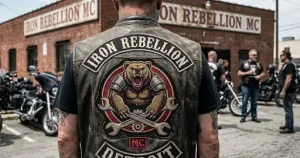
It is imperative to note that, while the outlaw clubs zealously protect their three-piece set patches, the entire bikers’ community is equally dependent on embroidery to display their love for the open road. One must take utmost care to distinguish between alleged territories of outlaw bikers and other riders.
Many independent riders, as well as charity organizations and groups that enjoy riding together on weekends, are interested in purchasing high-quality custom biker patches that can help them commemorate rallies, honor deceased friends, or simply exhibit their individual style preferences. Explore the right types for your biker patches.
These groups carefully refrain from adopting the three-piece style and/or “MC” cube to avoid unintentionally offending territorial clubs. Being aware of which MC patches to avoid helps protect you from unwanted trouble.
If you would like to produce unique and eye-catching designs for your own riding association, charity ride, or just an individual leather vest, then you should certainly consider working with our professional manufacturing company.
At Patch Makers USA, we pride ourselves on being able to create outstandingly strong motorcycle vest rockers and patches without disrespecting established club traditions in any manner whatsoever. Our services allow for making an enormous center patch for your local riding club or, on the contrary, a funny phrase that will appear on your vest’s front.
Frequently Asked Questions
Are civilians allowed to wear Hells Angels support patches?
Yes, civilians and even friends and relatives are strongly advised to buy and wear their official support merchandise that usually displays the number 81 or the official support slogans. Doing so will demonstrate their monetary and social support for the organization’s local branch. But then again, a civilian must not in any way display the official winged Death Head insignia nor act as a patched member since this is extremely offensive on the part of real members.
What happens if a motorcycle club member loses their patches?
The loss of colors is a complete dishonor in the context of traditional motorcycle clubs. In case your vest is taken away or lost through any means, you will be facing an internal problem, which might lead to serious consequences for yourself, like a fine or even worse punishment. You are supposed to guard the patches of your vest like nothing else, and failing in doing so shows you completely lack respect for your brothers in arms.
Can any riding group wear a three-piece patch on their vests?
For an informal ride group or club that has just been formed, it would be very unwise indeed to come up with a three-piece patch, especially where a territorial bottom rocker is used. The use of territorial patches by informal biker groups without the express permission of the dominant outlaw club within that region is seen as an outright declaration of war. Informal groups have one-piece or two-piece patches to show that they are not staking any claims to territory.
How are motorcycle patches attached to a heavy leather vest?
However, because of the thickness and toughness of the motorcycle leather, the patches cannot be stuck with regular adhesive methods like iron-on. The ironed-on patches would simply fly away during a ride on the highway. It is a common practice among most bikers to give the leather jackets to skilled leather workers, cobblers, or tailors to stitch the custom embroidered patches on them.
Order Your Custom Motorcycle Patches Today
Whether you are organizing a weekend charity ride, outfitting a massive national riding club, or simply looking to add some rugged personal flair to your favorite leather jacket, the quality of your thread matters.
At Patch Makers USA, we understand the deep pride, rich history, and road-tested durability required to create perfect emblems for the motorcycling community. We offer unparalleled craftsmanship, precise digitizing, and rugged materials designed to withstand decades of harsh highway winds and blazing sun.
Do not settle for cheap imitations of motorcycle club patches that will fade and fray after a single riding season. Bring your boldest designs to life and represent your crew with ultimate pride. Contact Patch Makers USA today to start crafting your premium, road-ready patches.
